Every chapter of aviation history has a name attached to it. Some pilots built the machines, some flew farther or faster than anyone before them, and some broke barriers that had nothing to do with engines. The aviators below shaped flight between 1903 and 1964, from a 12-second hop on the North Carolina coast to a woman’s solo flight around the globe.
The pioneers: proving that flight works
Wilbur and Orville Wright
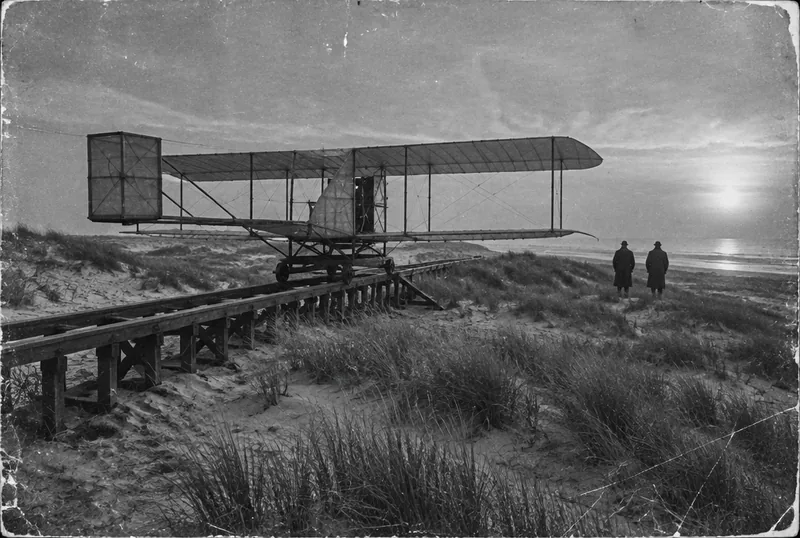
On December 17, 1903, at Kill Devil Hills near Kitty Hawk, North Carolina, Orville Wright made the first controlled, sustained flight in a powered airplane: 120 feet in 12 seconds. Wilbur flew the fourth and longest flight of the day, 852 feet in 59 seconds. Their real breakthrough was not the engine but control. The Wrights developed three-axis control, which lets a pilot manage roll with wing warping, pitch with an elevator and yaw with a rudder. Every airplane built since uses the same principle. The full story is told in our article on the history of the first airplane.
Louis Blériot
On July 25, 1909, the French inventor Louis Blériot took off near Calais in his Blériot XI monoplane and landed at Dover about 36 minutes later. It was the first flight across the English Channel and won him the London Daily Mail’s £1,000 prize. The crossing showed that the sea no longer protected Britain from the air, and orders for his monoplane poured in. Blériot’s company went on to build many of France’s military aircraft in the First World War.
Breaking barriers for women and Black aviators
Harriet Quimby
Harriet Quimby, a journalist and screenwriter from Michigan, became the first American woman to earn a pilot’s license from the Aero Club of America on August 1, 1911. On April 16, 1912, she became the first woman to fly across the English Channel, from Dover to the French coast. Her achievement was overshadowed in the press by the sinking of the Titanic the day before. On July 1, 1912, Quimby and her passenger were thrown from her airplane over Boston Harbor during an air meet and were killed. She was 37.
Bessie Coleman
Bessie Coleman grew up in Texas and worked as a manicurist in Chicago. American flight schools refused to accept her because she was Black and a woman, so she learned French and trained at the Caudron brothers’ school in France. In June 1921 she received her license from the Fédération Aéronautique Internationale, becoming the first African American woman to hold a pilot’s license. She performed as a stunt pilot across the United States and refused to fly at shows where Black spectators were segregated. She died in a crash in Jacksonville, Florida, on April 30, 1926.
Amelia Earhart
Amelia Earhart became the first woman to fly solo nonstop across the Atlantic on May 20 and 21, 1932, flying a Lockheed Vega from Harbour Grace, Newfoundland, to a pasture in Northern Ireland in about 15 hours. Congress awarded her the Distinguished Flying Cross. In January 1935 she became the first person to fly solo from Honolulu to Oakland, California. Two years later, with navigator Fred Noonan, she attempted a flight around the world near the equator. On July 2, 1937, their Lockheed Electra disappeared while searching for tiny Howland Island in the central Pacific. Despite one of the largest searches in U.S. Navy history, the aircraft was never found.
Jacqueline Cochran
Jacqueline Cochran won the Bendix transcontinental air race in 1938 and set more speed, altitude and distance records than any other pilot of her time. During World War II she led the Women Airforce Service Pilots (WASP), who ferried military aircraft across the United States. On May 18, 1953, flying a Canadair-built F-86 Sabre, she became the first woman to fly faster than the speed of sound.
The Tuskegee Airmen
From 1941, the U.S. Army Air Forces trained Black pilots, navigators and ground crews at Tuskegee Army Air Field in Alabama. Nearly 1,000 pilots earned their wings there. The 99th Fighter Squadron and the 332nd Fighter Group, whose P-51 Mustangs had red-painted tails, flew combat missions over North Africa, Italy and Germany and escorted bombers deep into enemy territory. Their record helped persuade President Harry Truman to order the desegregation of the armed forces in 1948.
Distance and endurance records
Charles Lindbergh
On May 20 and 21, 1927, Charles Lindbergh flew the Spirit of St. Louis alone from Roosevelt Field on Long Island to Le Bourget airfield near Paris, about 3,600 miles in 33.5 hours. The flight won the $25,000 Orteig Prize and made Lindbergh the most famous man in the world. Within a few years airline passenger numbers in the United States grew several times over, a surge often called the Lindbergh boom.
Wiley Post
Wiley Post, a one-eyed former oil field worker from Oklahoma, flew around the world in 1931 with navigator Harold Gatty in 8 days and 15 hours. In July 1933 he repeated the trip alone in his Lockheed Vega Winnie Mae, covering about 15,600 miles in 7 days and 19 hours, the first solo flight around the world. He relied on an autopilot and radio direction finder, then new. Post also developed one of the first practical pressure suits for high-altitude flight and was among the first pilots to report the strong high-altitude winds later called the jet stream. He and the humorist Will Rogers died in a crash near Point Barrow, Alaska, in August 1935. The Winnie Mae hangs in the National Air and Space Museum.
Jerrie Mock
Geraldine “Jerrie” Mock, a mother of three from Columbus, Ohio, took off on March 19, 1964, in a single-engine Cessna 180 named Spirit of Columbus. She returned on April 17, 1964, after about 22,800 miles and 29 days, the first woman to fly solo around the world. She received the Federal Aviation Agency’s Exceptional Service Decoration from President Lyndon Johnson and the Louis Blériot Medal of the Fédération Aéronautique Internationale. Her plane is displayed at the Smithsonian’s Steven F. Udvar-Hazy Center.
Speed: beyond the sound barrier
Chuck Yeager
On October 14, 1947, Air Force Captain Chuck Yeager flew the rocket-powered Bell X-1, which he named Glamorous Glennis after his wife, to Mach 1.06 over Rogers Dry Lake in California. It was the first confirmed supersonic flight in level flight. Yeager flew with two broken ribs from a riding accident days earlier. More on that day in our article on the first supersonic flight.
What these aviators had in common
Most of these pilots flew with little margin for error: no weather radar, no satellite navigation, often no radio. Several died young doing the work that made them famous. What they shared was careful preparation combined with a willingness to go first. Their records were broken long ago, but each one moved the boundary of what people believed an airplane, and its pilot, could do.
Frequently Asked Questions
Who was the first woman to fly solo across the Atlantic?
Amelia Earhart, on May 20 and 21, 1932, from Newfoundland to Northern Ireland.
Who flew solo around the world first?
Wiley Post, in July 1933 in the Winnie Mae. The first woman to do so was Jerrie Mock in 1964.
Who was the first licensed female pilot in the United States?
Harriet Quimby, licensed by the Aero Club of America on August 1, 1911.
Who first broke the sound barrier?
Chuck Yeager, in the Bell X-1 on October 14, 1947. Jacqueline Cochran was the first woman to do it, in 1953.